Organizers of Al-Aqsa Flood Conference Reject Canada’s Terror Listing of Alternative Revolutionary Path
The organizing committee of the Three Years Since Al-Aqsa Flood conference rejects Canada’s decision to place the Alternative Palestinian Revolutionary Path on its terror lists and affirms that the Toronto conference will go ahead.
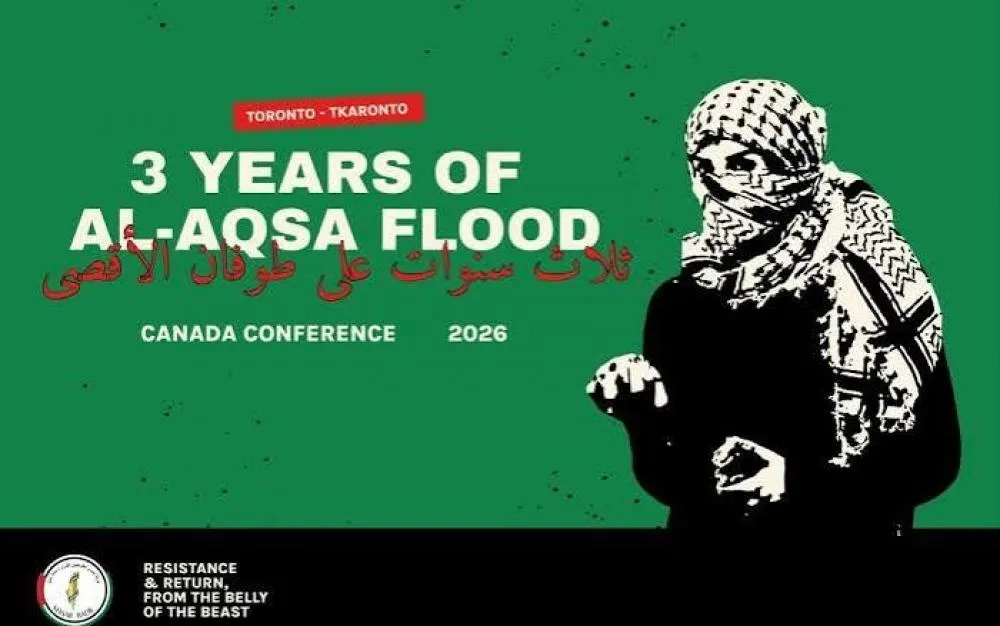
The organizing committee of the “Three Years Since Al-Aqsa Flood” conference in Canada has announced its rejection of the decision by Prime Minister Mark Carney’s government to place the “Alternative Palestinian Revolutionary Path” movement on what is known as its terror lists, describing the move as part of a political campaign targeting Palestinian action in the diaspora and international solidarity with the Palestinian cause.
In a statement titled “The Three Years Since Al-Aqsa Flood Conference Continues on the Revolutionary Path,” the committee said the listing decision, issued on November 23, came after months of pressure exerted by institutions aligned with the occupation on the Canadian government, aimed at preventing the conference from being held and placing the movement on the list.
The committee pointed to a letter sent by Israeli Minister for Diaspora Affairs Amichai Chikli to Canadian Prime Minister Mark Carney on November 19, in which he demanded an urgent security assessment of the conference.
It argued that the listing decision being issued just four days after the letter was sent indicates, as it put it, that the Canadian government responded to Israeli pressure.
The statement reviewed the circumstances in which the “Alternative Palestinian Revolutionary Path” movement was founded in 2021, through conferences held in Madrid, Beirut and São Paulo, noting that the movement adopts positions rejecting the Oslo Accords.
It explained that the movement’s principles are based on liberation and return, restoring the role of Palestinians in exile and the diaspora, and working to establish a unified Palestinian national front.
The committee linked the Canadian government’s policies toward the Palestinian movement to Canada’s colonial history and its practices against Indigenous peoples, arguing that the use of security classifications against political movements infringes on public freedoms and the rights of peoples.
It called for the cancellation of what it described as Canada’s “terror list” and for an end to measures aimed at restricting international solidarity with the Palestinian people.
At the conclusion of its statement, the organizing committee affirmed its commitment to holding the “Three Years Since Al-Aqsa Flood” conference in the city of Toronto on the scheduled date, stressing that the Alternative Palestinian Revolutionary Path is not limited to a single person or organizational framework but represents a political project grounded in Palestinian national rights.