Gaza’s Toxic Contamination: International Report Exposes Scale of Environmental Catastrophe and Risks to Future Generations
An international report warns of an environmental catastrophe in Gaza caused by Israeli military operations, with contamination indicators affecting more than 99 percent of the territory and health risks threatening residents and future generations.
Translation / Shehab
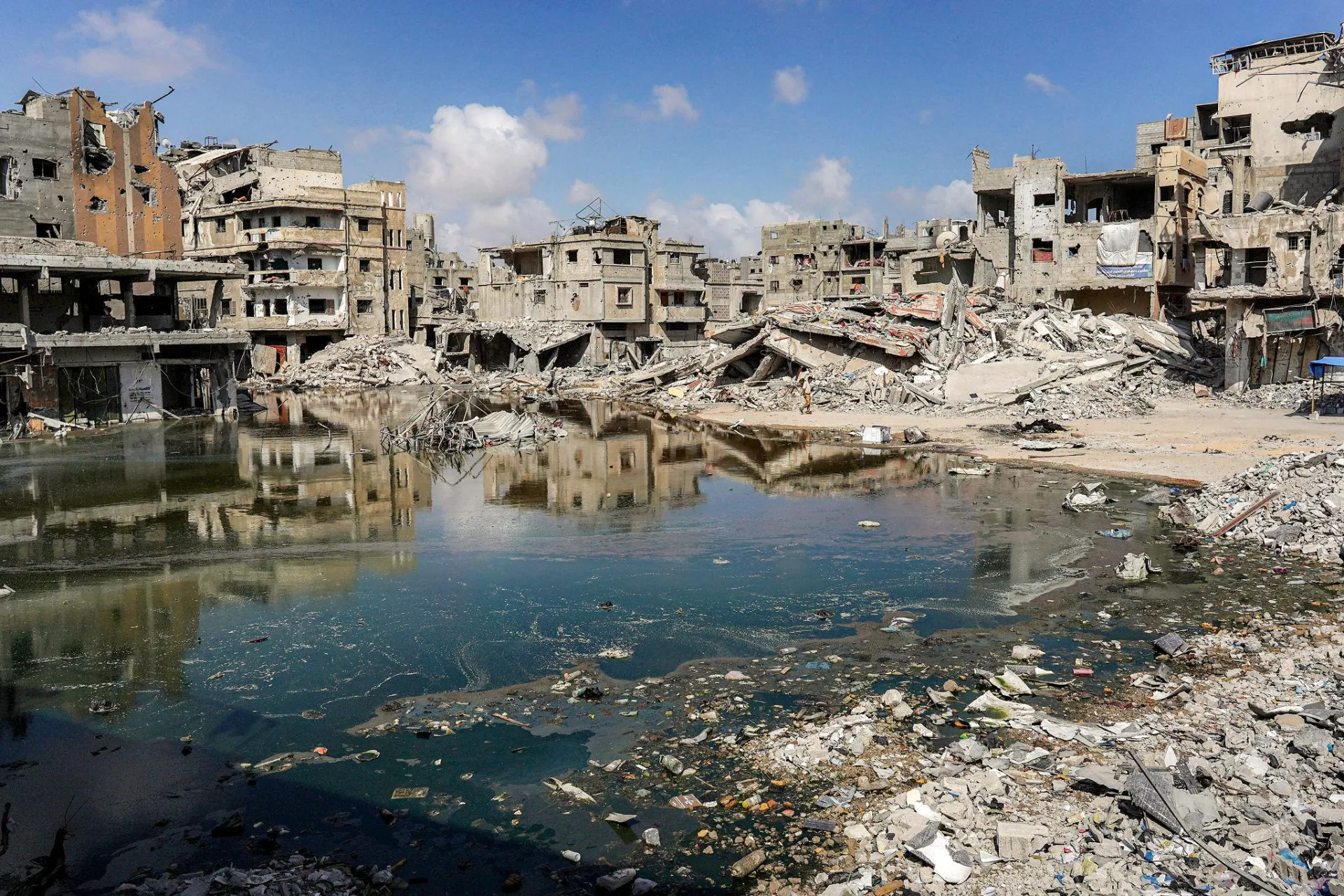
A joint environmental report by Oxfam and the Conflict and Environment Observatory (CEOBS) has warned of a wide-scale contamination catastrophe left by Israeli military operations in the Gaza Strip, confirming that potential contamination indicators cover more than 99 percent of the territory and that its health and environmental repercussions could last for decades and extend to future generations.
The British newspaper The Guardian said in a report published on Monday, 23 November 2026, that the destruction caused by the occupation army was not limited to homes, facilities and infrastructure, but extended to poisoning the basic environmental elements of life, including water, soil and air, due to explosives residues, heavy metals, asbestos, sewage and pollutants from fires and the destruction of buildings.
Environmental war crimes
According to the report, titled “Environmental War Crimes: How the Israeli Military Attack Turned Gaza into a Toxic Land Threatening the Survival of Residents,” spatial analyses showed that about 78 percent of the territory’s land area was severely affected by military operations, while potential contamination indicators were detected in more than 99 percent of its area, reflecting the scale of environmental risks and the difficulty of confining them to specific zones.
The assessment drew on satellite imagery, remote sensing technologies, scientific analyses and open-source data, alongside previous studies on contamination caused by armed conflicts in other countries, amid the impossibility of conducting comprehensive field tests inside Gaza due to Israeli restrictions on the entry of testing equipment and independent technical expertise.
Oxfam International’s executive director, Amitabh Behar, said that the military destruction of Gaza’s environment represents a direct threat to life and carries repercussions that could last for generations, noting that the destruction and contamination of the environment has undermined the conditions necessary to ensure the safety and survival of residents.
He added that Palestinians are exposed to toxic substances through air, food and water, as well as through contact with contaminated soil and rubble, warning that these risks will persist unless cleanup, treatment and environmental recovery operations are prioritized.
He explained that the high population density and the small size of the territory, along with the collapse of sewage systems and the spread of waste and pollutants, make avoiding exposure to these risks extremely difficult and raise the likelihood of disease and pest outbreaks.
Rising faecal bacteria
He noted that untreated sewage flows into the sea and seeps into the soil, while the destruction of sewage networks has left residents without basic protection from contamination, pointing out that children and pregnant women face greater health risks due to continuous exposure to pollutants.
The report revealed alarming indicators regarding contamination of water sources in the territory, as analysis of samples collected from 79 groundwater wells during July 2026 showed the presence of faecal coliform bacteria in 19 percent of them, compared with about 2 percent of wells recorded as contaminated in 2021, an increase of nearly tenfold.
The risks are compounded by the widespread collapse of the sewage system, with only 19 percent of sewage pumping stations still operating, while only 30 percent of the sewage treatment and collection network is functioning at partial capacity.
According to data from the Palestinian Coastal Municipalities Water Utility, on which the report relied, about 40,000 cubic metres of raw sewage are discharged daily into the Mediterranean Sea, while about 15,000 additional cubic metres per day leak from the collection network through absorption pits and other seepage pathways.
The report warned of heightened risks of drinking water contamination in northern Gaza, Gaza City and Deir al-Balah, where wells and desalination plants still in operation overlap with highly fragile groundwater layers and areas subjected to intense bombardment and accumulated rubble, while flooding and sewage overflow increase the likelihood of pollutants reaching water sources.
Long-term contamination
Regarding soil, the report warned of long-term contamination risks in the areas of Beit Hanoun, Wadi Gaza and northeastern Khan Younis, due to the clay-rich nature of the soil, which tends to retain pollutants for long periods, potentially threatening the safety of food crops when agricultural activity resumes.
On air pollution, the report identified Gaza City, Jabalia camp and the North Gaza governorate as among the most exposed areas, as a result of contaminated dust rising from intense bombardment and the destruction of buildings, and then particles and harmful substances returning to the air due to winds, vehicle movement and rubble removal work.
It noted that dust from destroyed buildings and waste burning exacerbates respiratory risks and may lead to irritation of the respiratory system and worsening of asthma and lung injuries, with concerns of long-term damage due to continued exposure to hazardous materials, especially among children, who are more sensitive to these pollutants.
It also warned of the spread of asbestos, heavy metals, explosive residues, organic pollutants, dioxins and biological pollutants, which can be transmitted through air, water and food or through direct contact with contaminated soil and rubble.
Open stores of hazardous materials
In an indication of the scale of the catastrophe, the United Nations Environment Programme estimated that Israeli military operations left behind more than 61 million tonnes of rubble and debris across the Gaza Strip, turning residential neighbourhoods and destroyed buildings and infrastructure into potential sources of toxic and hazardous materials.
The report explained that the volume of rubble in Gaza is equivalent to about eight times the debris left by the conflict in the Iraqi city of Mosul in 2017, and three times the total rubble generated by the war in the Syrian cities of Aleppo and Homs.
The danger posed by these quantities is not limited to the difficulty of removing them; it extends to the potential spread of contaminated materials into soil, water and air, as the rubble continues to break down, dust rises and pollutants migrate to surrounding areas.
The report’s author, Lama Abdel Samad, Oxfam’s global specialist on water and sanitation, said addressing the environmental damage in Gaza will be extremely complex, given the spread of pollutants across urban rubble, agricultural land, water networks and soil.
She added that the presence of unexploded ordnance restricts safe access to most areas and obstructs damage assessments and remediation work, stressing that a comprehensive field environmental assessment must be permitted to identify sources of contamination and levels of risk and to set urgent measures to limit the damage.
Risks That Span Generations
The report noted that restrictions on the entry of testing equipment and technical experts have prevented an independent and comprehensive environmental assessment on the ground, meaning the true scale of the contamination, its types and the areas it has spread to remain not fully determined.
It warned that proceeding with arrangements for Gaza’s reconstruction without conducting an environmental assessment and addressing the sources of contamination could reproduce the same risks within the neighbourhoods and residential areas being rebuilt.
According to the report, recovery requirements include removing vast quantities of rubble, conducting continuous monitoring of hazardous materials, specialised treatment of areas affected by explosive remnants, organic pollutants and heavy metals, along with testing water, soil and air sources.
It also called for enabling independent experts and technical teams to access the Strip, providing the funding needed for an environmental assessment led by Palestinian bodies, and drawing up an integrated programme for cleanup, remediation and safe reconstruction.
Oxfam stressed that environmental recovery must be a fundamental part of the Gaza reconstruction plan, not a deferred or secondary file, demanding that the recovery and rebuilding process be Palestinian-led and based on rights, accountability and reparation, affirming that international funding does not absolve the occupation of its responsibilities for the damage it caused.
In the same context, the report estimated that carbon emissions associated with the phases of the war and the reconstruction that follows amount to about 33.2 million tonnes of carbon dioxide equivalent, roughly equal to total Palestinian national emissions over about six years, according to 2023 levels.
Behar said that reconstructing Gaza without understanding the scale of environmental contamination and addressing it in tandem with construction work carries long-term health risks that future generations may bear, stressing the need to include environmental assessment and remediation among recovery and reconstruction priorities.