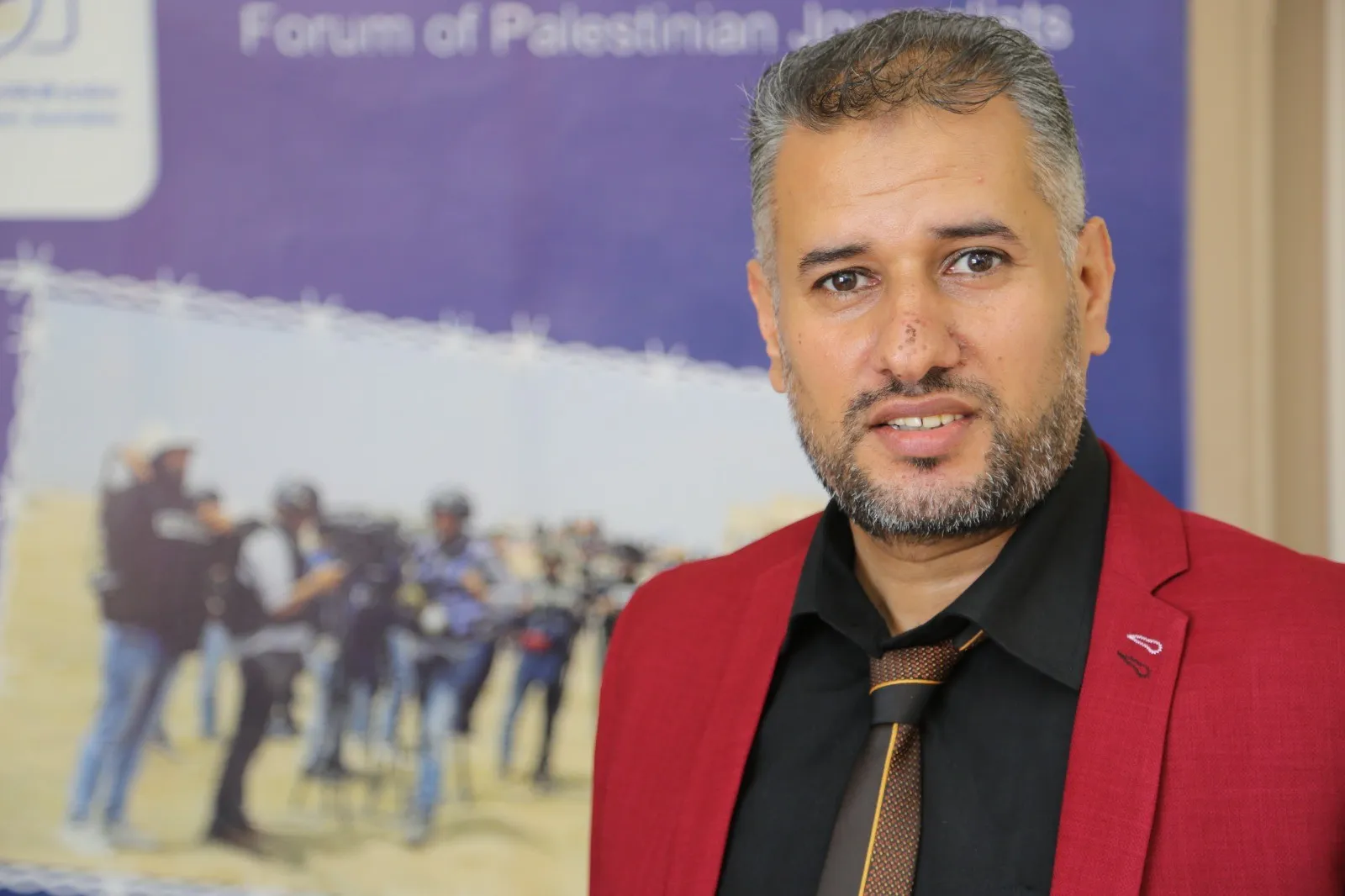
Emad Al-Ifranji on Shehab: It Waged Media Wars and Set a Legendary Example of Steadfastness and Creativity
Veteran journalist Emad Al-Ifranji affirmed that Shehab News Agency has waged media wars and set a legendary example of steadfastness and creativity in preserving Palestinian memory and documenting Israeli crimes despite the sacrifices.

Veteran Palestinian journalist and released prisoner Emad Al-Ifranji affirmed that Shehab News Agency has served as a powerful media arm for preserving Palestinian memory and the historical narrative, and for keeping the national cause alive in the collective consciousness locally and across the Arab world.
Speaking on the occasion of Shehab launching its website in its new design, Al-Ifranji said the agency, through a staff distinguished by dedication, professionalism, giving and sacrifice, has managed daily and continuous documentation of Israeli crimes, and that its media output has become an undeniable historical and legal archive.
He added that it has preserved the collective consciousness by focusing on highlighting the stories of displacement and depopulated towns, ensuring the narrative passes across generations from grandparents to grandchildren and defeating the saying that “the old die and the young forget.” It has succeeded in humanizing the cause by turning rigid numbers and statistics into human stories that shed light on individuals’ lives, dreams and daily suffering.
He explained that Shehab, despite its modest capabilities, has worked to refute misleading narratives by presenting facts, documents and live testimonies from the field, and to rebut and expose Israeli propaganda.
Al-Ifranji said Shehab has succeeded in its field coverage, especially in critical times and during wars, in imposing the true image and the Palestinian narrative on the media scene despite attempts at blocking.
He noted that it has helped keep the Palestinian cause a “central cause” in the conscience of Arab and Islamic peoples through its various output that addressed the shared conscience, and that its digital media platforms have largely succeeded in exerting Palestinian, Arab and international influence and creating an unprecedented state of popular solidarity.
He stressed that Shehab has paid a heavy price for bearing the trust of the word, professional ethics and national and societal responsibility, even as the occupation destroyed its headquarters and offices, and that it has faced a fierce war on social media platforms and restrictions on the reach of its media output because of its adherence to the truth and its support for Palestinians, their resistance and their true narrative.
The veteran journalist added that the agency has paid the price in blood and sacrifice, its credibility consecrated by martyrdom — that of its son, cameraman Hamza Shaheen, the agency’s photographer, in 2008 — and by the occupation’s arrest of two of its correspondents. He explained that these physical and professional sacrifices give its media output a credibility that cannot be questioned by the public, for audiences trust those who risk their lives to convey the truth.
He viewed the great trust and strong presence Shehab has earned as the inevitable result for anyone who adheres to truth, professionalism, credibility, accuracy, honesty and a bias toward the masses and closeness to them. It is a child of the field in reporting events objectively and accurately despite risks, whether internal or from the occupation. He added that the uninterrupted work of Shehab despite all hardships, dangers, emergencies and wars, and the presence of its correspondents at friction points and in hot zones around the clock, has made it the fastest and most accurate source of news, and of detailed documentation of human suffering and local stories, and of embracing Palestinians’ daily concerns, especially in Gaza.
Al-Ifranji pointed out that, given its boldness in upholding right and truth, it has fought violent media battles with the occupation and its backers, focused on the crimes committed against the Palestinian citizen — from the wall and arrests to the economic and social problems produced by living conditions — and embraced popular and humanitarian concerns.
He stressed that Shehab’s continuation in reporting the truth from the field during the genocide war, amid a systematic and unprecedented targeting, is a unique phenomenon in the history of modern journalism, classified as the highest degree of civil and professional resistance.
He said this legendary steadfastness “under fire” represents a human and professional epic, for journalistic work at Shehab has not been merely a job or a profession but an existential and national mission, with its crews, cameras and pens enlisted as a means of defending the Palestinian people and their existence, not only of reporting the news.
He added that journalists have overcome the psychological trauma of losing their families, colleagues, homes and all the essentials of life, and have continued coverage wearing the armor of the press, which has often turned into a target.
Al-Ifranji noted that everyone is aware of what journalists have endured to keep the message going and the image flowing from Gaza, and that they have paid very heavy prices for it, facing power, internet and communications cuts by devising alternative solutions such as international eSIM cards and relying on solar power to charge equipment and broadcast from atop hills of rubble or from inside hospitals.
He explained that they invented field newsrooms in displacement tents, hospital courtyards and destroyed cars, and reported the truth from ground zero, refusing silence and risking their lives to document massacres and violations the moment they occur.
He said Shehab, along with the rest of the Palestinian media, has broken the Western media monopoly and imposed the true narrative, and that its correspondents, thanks to their determination, have succeeded in piercing the media siege that major powers tried to impose, forcing global media outlets to adopt the Palestinian narrative and live field images because there is no alternative on the ground.
He stressed that Shehab’s continuation — management and journalists alike — in working under fire is not merely reporting events but a conscious act of steadfastness that prevents the erasure of the truth and denies the perpetrator the chance to commit his crime in the dark.
Al-Ifranji addressed a message to Shehab and its journalists in the field, saying it is a salute of reverence and pride in their professional and human creed, and a pledge of loyalty to their sacrifices that have made truth an unbreakable weapon.
He said they are “the eye of the world and the guardians of the narrative, and were it not for their presence at the heart of danger, in the darkest conditions under fire and siege, crimes would have been committed in the darkness of oblivion; they have written history with their blood and patience and kept the Palestinian narrative alive in the conscience of humanity.”
He added that with their simple tools and their bravery they have succeeded in piercing the strongest systems of global disinformation, conveying the voice of the victim and the cry of the wronged directly to the world’s conscience, and reordering peoples’ awareness of the justice of the Palestinian cause.
He stressed that the most important message is a call to safeguard their safety and lives as much as possible, for the truth needs those who continue to convey it, and their living voice is the guarantee that keeps the cause present and ongoing until freedom, justice and victory over the enemies are achieved, addressing them: "Peace to your sleepless eyes, and to your hands that grip the camera and the pen as one grips a burning ember."
Speaking about the new website, Al-Ifranji said that for a local Palestinian agency to secure an advanced place in the Arab media landscape and compete strongly, it must move beyond the traditional news format to a stage of digital professionalism, in-depth content creation and a global humanitarian discourse, in order to serve the Palestinian cause in an unconventional way.
He added that he advises, first of all, adherence to the highest standards of credibility and fighting fake news to build a brand trusted by the Arab reader and decision-makers, and investing in "visual media" and "snackable content" by focusing on short videos (Reels/Shorts), infographics, and news and knowledge podcasts.
It is worth noting that Shehab News Agency is a Palestinian news agency founded on January 1, 2007, in the Gaza Strip. It is considered one of the largest Palestinian news agencies and is followed by a wide segment of the Arab and Islamic world on its digital platforms, despite its pages having been shut down more than once.
The agency works around the clock to convey the true picture of events on the Palestinian scene, entrench the principles of free professional media, and document facts in sound and image so they reach the world. It also provides news, production and technical services to local, Arab and international media institutions.
The agency launches its new website on the eleventh of November this month, in a new phase of its media journey.