Gaza's Public Workers Caught Between Meager Salaries and Traders Refusing Cash as Financial Crisis Deepens
A prolonged financial and living crisis leaves Gaza's public employees squeezed between meager salary payments and traders refusing worn banknotes, as the genocidal war continues amid extremely difficult living conditions.

Shihab exclusive
The humanitarian suffering endured by some 45,000 families supported by government employees in the Gaza Strip, whose household members total nearly 400,000 people, is mounting.
These employees, who throughout the war years and before formed the backbone sustaining essential services in health, education, security and municipalities, now find themselves caught between two absolute fires: the fire of sporadic, limited payments disbursed every few months, and the fire of a crisis over circulating worn currency, with some vendors and traders refusing to deal in the scarce cash available in the markets.
This stifling living crisis comes as a new payment is being disbursed in recent days, after successive stretches of harsh waiting. The head of the public employees' union in the Gaza Strip, Khalil Hamada, said earlier that employees have received only three limited payments since the start of this year, noting that what has been paid over long months amounts to only about $650 (or scattered advances not exceeding 2,000 shekels), a sum whose effect vanishes entirely in the face of rampant price rises and eroding purchasing power.
"Blood while on duty"
Despite the ferocity of living conditions and the severity of the financial crisis, civilian employees and members of the security and police forces in the Gaza Strip continue to carry out their duties and provide essential services to citizens, undeterred by the direct and systematic targeting they face from the "Israeli" occupation forces, which seek to disrupt the work of institutions and strike at the home front.
In this ongoing bloodshed, the "Israeli" occupation army recently committed a horrific massacre targeting a group of public-sector civilian employees, in a treacherous strike on a work point belonging to the Ministry of Economy in the al-Mawasi area of southern Gaza — an area crowded with civilians — killing four people and injuring dozens while the employees were performing their professional duty inspecting goods, verifying their validity and protecting society from illegal materials.
The hand of aggression did not stop there; it extended to targeting civilian police while they carried out their duties maintaining security and order in Khan Younis today, in a continuation of the systematic series of crimes documented by the Ministry of Interior and National Security. These repeated "Israeli" strikes have killed and injured dozens of police officers and members since the ceasefire took effect last October, raising the toll of martyrs among government and police cadres to thousands, killed while at their field posts of duty.
"The government employee on the brink of collapse"
In an analytical reading of the economic crisis, economist Ahmed Abu Qamar said that a government employee in the Gaza Strip receiving only 1,000 shekels after about 100 days of waiting means the average he gets per day does not exceed 10 shekels — a paltry sum wholly unable to cover the simplest daily needs amid soaring prices and eroding purchasing power.
Abu Qamar explained that the problem goes beyond a delayed salary to form a crisis stretching back about three years, worsening due to financial chokeholds and "Israeli" restrictions.
He stressed that the government employee must not be viewed merely as a breadwinner awaiting his allotment, but as the pillar of institutions and public services; among them is the doctor struggling to save the wounded, the teacher trying to resume education among the tents, and the oversight employee reining in monopolies and price manipulation. He warned that the collapse of their conditions would completely paralyze the capacity of service institutions.
He added that the repercussions of the crisis have dealt a mortal blow to local markets, as the decline in the incomes of thousands of employees has sharply reduced consumption and purchasing power, deepening recession and extreme poverty and creating a vicious cycle of economic contraction.
Abu Qamar noted that the issue now threatens the continuity of the entire government sector, requiring urgent action by mediators and international parties to press for sustainable solutions, alongside Palestinian efforts to integrate civilian-sector workers and guarantee their financial and employment rights, so that the employee is not left alone to face collapse.
A silent human ache and fear for families
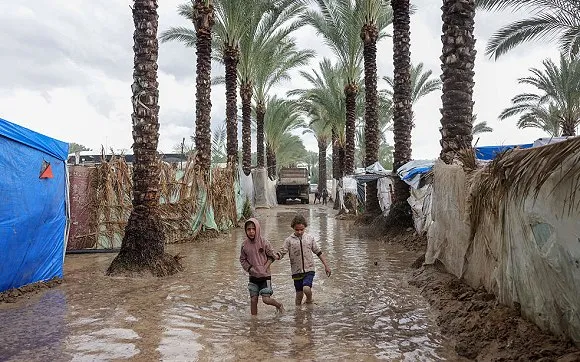
On the ground, the repercussions of the crisis are embodied in painful human scenes lived by Gaza's public workforce. While government institutions have sacrificed thousands of their cadres — police, medical and civil defense crews — during the war, the remaining employees continue to perform their humanitarian and service duties, walking long distances on foot or staying inside hospitals and service centers for days amid the destruction.
A police officer recounts part of this human and living burden, explaining that at one point he found himself unable to secure the fare for a vehicle to take his wife to hospital in labor, and had to borrow the money from relatives to make the trip.
Abu Omar adds, his voice choked with pain, that his family lived for long months on scarce food and simple charity-kitchen aid, while he was utterly unable to provide his children's basic necessities, milk or medicine.
The suffering does not stop at delays and paltry sums; employees recently hit an additional obstacle in the worn condition of banknotes and the difficulty of spending the 1,000 shekels issued as a payment, as segments of vendors and traders refuse to accept them because the paper currency is damaged and new cash is absent from the besieged Strip.
Employees express fear that this situation will worsen, asking with much pain and pleading: "After waiting 100 days to receive a limited sum that is not enough to pay off debts or cover lighting or phone charges, how can an employee return home unable to buy medicine or his children's needs because the banknotes are not accepted in the market?"
Others add in appeals reflecting their concern to protect their families' dignity: "We are not asking for charity, but we hope to protect the employee's rights and provide mechanisms that ensure salaries can circulate and be accepted in the markets, to secure a decent living for our children, who cannot comprehend the scale of rejection and living hardship."
A Collective Responsibility and Aspirations for Fairness
The Employees’ Union and local community bodies affirm that the government employee in Gaza represents the safety valve for civil services. Officials and union figures commend the great steadfastness of medical crews who never left their posts, along with municipal and civil defense teams and police officers who continued working despite the occupation’s bullets and bombardment to secure the minimum conditions of safety and stability for displaced people.
According to observers, as talks and international and local efforts continue regarding the management and arrangement of the next phase in Gaza, the issue of the 45,000 employees remains a profoundly humanitarian and moral file that requires an urgent response from all parties and responsible bodies. Fair treatment of the employee and the preservation of his dignity and his financial and employment rights is the first line of defense for the stability of society and relief for needy families, so that those who bandage Gaza’s wounds and safeguard its services are not left alone to face destitution and the bitterness of need.