The Only Photo of Deif in the West Bank: Who Were the “Unit of Horrors” Fighters Who Founded Qassam in Hebron?
A rare photo bringing together Mohammed Deif and Amjad Abu Khalaf reveals details of the founding of Qassam in the West Bank and the “Unit of Horrors” that led the 1994 clashes in Hebron.
Report – Shahab
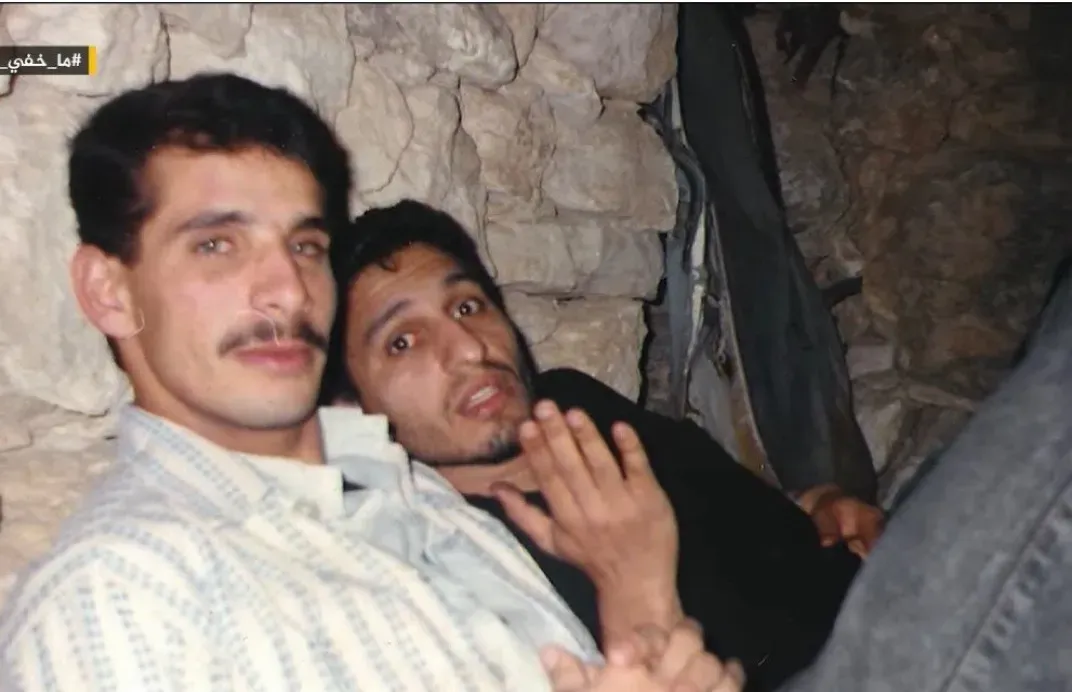
An episode of “Ma Khafi A’zam” about commander Mohammed Deif, broadcast by Al Jazeera on Friday evening, has brought back to the fore a rare archival photo showing him alongside one of the fighters of the Qassam “Unit of Horrors” in Hebron, opening discussion of an early phase in the establishment of the military wing of the Qassam Brigades in the West Bank, much of whose detail had long remained out of circulation.
The photo, according to what the programme showed, shows Deif alongside the martyr Amjad Abu Khalaf inside a cave. The Qassam Brigades have identified Abu Khalaf as one of its martyrs and a member of what was known as the “Unit of Horrors” in Hebron.
In his testimony aired by the programme, Deif recounted how he moved from the Gaza Strip to the West Bank after the space for action in the Strip narrowed because of a shortage of weapons, and that the martyred leader Muhyi al-Din al-Sharif took him to Bethlehem, from where he built ties extending to Hebron and Jerusalem.
He said the group he worked with moved at night among the mountains to scout routes and train, and the investigation noted that Deif took command of Qassam groups at the end of 1993, succeeding Imad Aql.
A few weeks after that phase, on 13 January 1994, four Qassam fighters fought a clash that lasted 12 hours after Israeli occupation forces besieged the house in which they had taken cover, and they refused to surrender. They were: Amjad Abu Khalaf (22), from Hebron, the man in the photo with Deif; Amjad Shabana (20), from Hebron; Farid al-Jaaba (23), from Hebron; and Mohammed Saleh Kamil (22), from Qabatiya, south of Jenin.
The martyrdom of the founders did not end the unit’s work; according to what has been published about its history, commander Yahya Ayyash reorganised it under the name “Unit for the Defence of Palestinian Civilians”.
Qassam records credit it, in January 1995, with ambushes and attacks in Hebron, including an ambush on a settlers’ bus at “Ras al-Joura” carried out by Jihad Ghalma and Taher Qafisha, in which the occupation admitted two killed and five wounded, and an attack on a military jeep on the Beit Kahil road in which three soldiers were wounded.
On 19 March 1995 it carried out an ambush on a bus at the Qazzazin junction, in which the settlers’ aide Moshe Levenger was killed and seven wounded, even though the bus was guarded by a military patrol, and the perpetrators withdrew unharmed.
In all, the unit’s operations resulted in the killing and wounding of more than 22 soldiers and settlers.
The episode, with its photo and Deif’s testimony, adds a visual thread linking the Qassam leadership in Gaza to the groups that formed in the West Bank, and offers names that had remained in the shadows for decades, bringing them back to memory with the faces and ages of young men in their early twenties.